Biophilic Design & Primal Architecture: Designing for the Nervous System First
We were never meant to live disconnected from nature – and our minds, bodies, and nervous systems know it.
Stress, anxiety, and a quiet sense of unease have become the backdrop of modern life, in large part because the spaces we inhabit have drifted so far from the natural world that once sustained us.
The good news? Wellness design can help bring us back.
In this 11th post of the Happy by Design series, we go deeper into the science of wellness design – exploring how biophilic design and primal architecture work together to create spaces that heal. From the nervous system’s instinct for safety to the brain’s measurable response to light, materiality, and form, discover how the homes we inhabit can be intentionally designed to nurture the mind, body, and soul.

A Common Misconception of Biophilic Design
In our last blog, Biophilic Design: Elements of a Naturally Happy Home we discussed the elements of water, air, earth, and fire, their contribution to human health and evolution, and how biophilic design can recreate each of these elements in the home.
A common misconception of biophilic design is that these techniques only create homes using natural elements and look like a forest scene with trees growing through your great room and furniture that looks like a beehive. And though design elements that literally bring the outdoors inside can be applied with biophilic design, this is NOT the only way. You do not have to compromise your personal preferences and styles in order the reap the benefits of a home designed with biophilia in mind.
A bevy of scientific evidence explains why certain natural spaces produce healing properties and how we can integrate those components in our homes without having to invite in the entire forest.
Primal Architecture
Long before we had words for it, we knew instinctively what a safe space felt like. A sheltered alcove. A fire at the center of the room. A high vantage point with a clear view of the horizon. These aren’t just aesthetic preferences – they’re deeply wired survival instincts, encoded into the human nervous system over thousands of years of evolution.
Primal architecture is the design discipline that honors those instincts. It recognizes that before the conscious mind registers a space as beautiful or functional, the nervous system has already decided whether it feels safe. This process – known as neuroception – happens automatically and continuously, scanning every environment for signals of threat or refuge.
When a space triggers a sense of threat, even subtly, the nervous system responds. Stress hormones rise, muscles tighten, focus narrows. Over time, living in spaces that keep the body on low-level alert contributes to fatigue, anxiety, and emotional depletion. Primal architecture works to reverse that – designing spaces that send the body a clear, consistent signal: you are safe here.
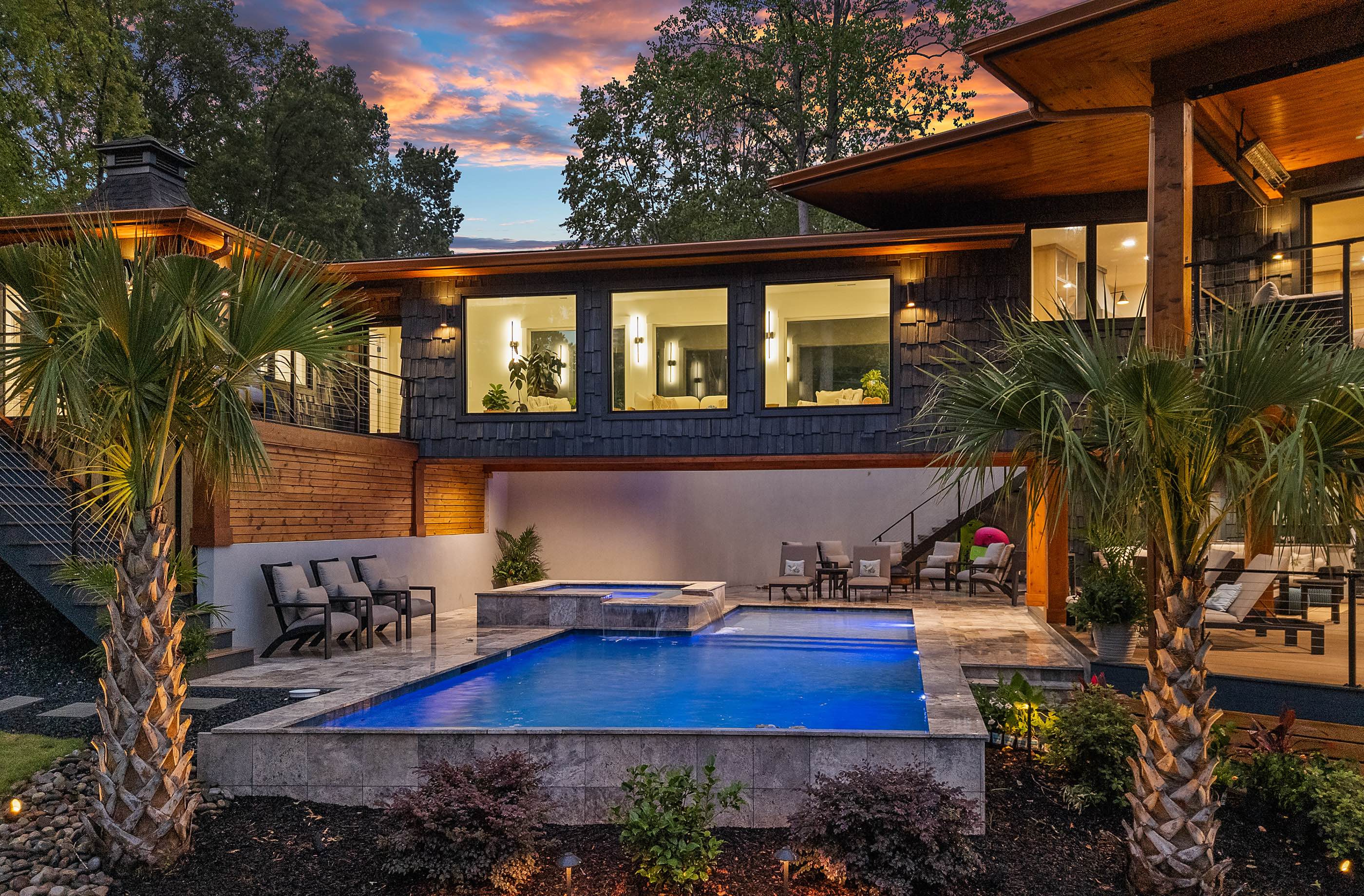
In practice, this looks like human-scaled proportions, natural materials, soft indirect lighting, clear sightlines, and spaces that balance openness with shelter. It’s the covered porch that draws you outside. The window seat that invites you to pause. The fireplace that anchors the room. Elements that feel instinctively right – because for thousands of years, they were.
Theory of Prospect & Refuge Environments
Researchers in the fields of Spatial and Environmental Psychology study the ability of different spatial configurations to evoke a positive sense of wellbeing. The Theory of Prospect and Refuge explains how certain environments meet the basic human psychological need to feel safe and secure. Prospect and refuge environments provide a view to see what’s coming towards you (prospect), while also providing protection where you can hide and not be seen by others (refuge).
In nature, a landscape of open fields where the eye can see for long distances can provide the sense of prospect, while an enclosed area of thick brush or a rock outcrop can provide refuge.
Prospect and refuge must work in tandem to achieve the
desired psychological outcome of feeling safe and secure.
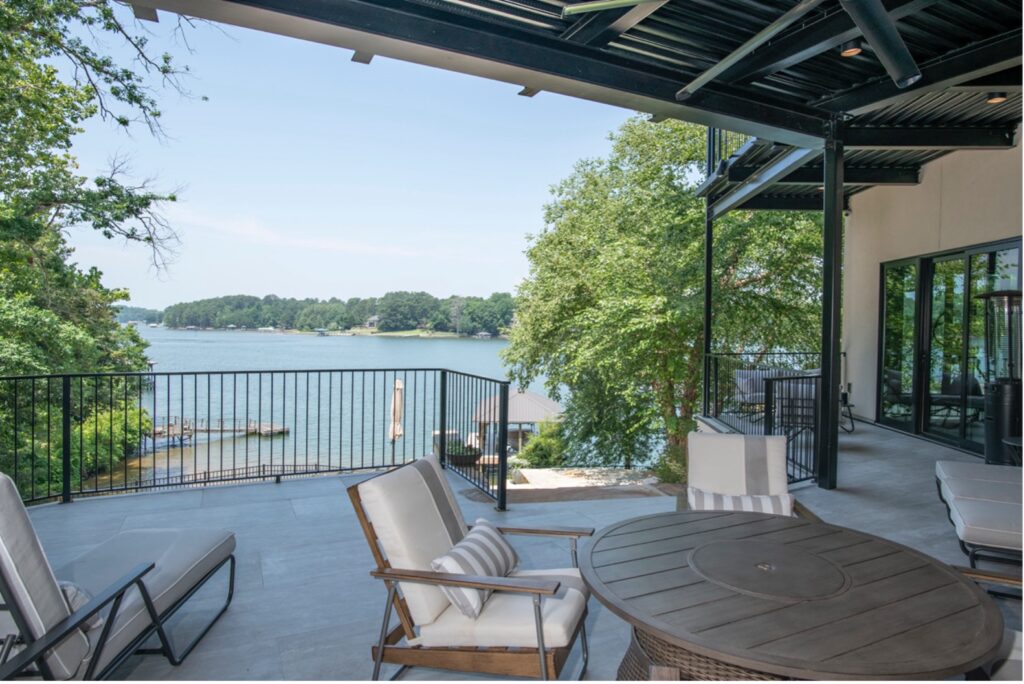
In the built environment (as seen above), a home designed with large windows and outdoor living spaces with great prospect over a lake view can be paired with deep porches and a u-shaped footprint that creates a sense of refuge, hidden from neighbors, and protection from the elements.

Environmental Preference Model: Legibility, Coherence, Complexity & Mystery
Your preferences are psychologically important because they influence behavior. Preference alone can dictate what property you buy, in what area of the nation, and even which room in the house you spend most of your time.
In 1982, Rachel and Stephen Kaplan created a model to describe how environmental preference is based on information, as opposed to just aesthetic beauty.
A preferred environment is one that provides quick information processing, understanding, and exploration.
Legibility and coherence refer to the environment’s ability to make sense to us and how easily and quickly we’re able to navigate around the space. A space that is cohesive and legible is preferable, however not to an extreme or else it becomes boring. We need aspects of intrigue and engagement to feel connected to and inspired by our surroundings.
Complexity refers to how much there is to see and think about. Too much complexity and the space becomes overwhelming and confusing. Too little complexity causes a space to feel boring and the individual isn’t motivated to explore further.
Mystery involves the intentional design of intrigue, sparking curiosity, and inspiring you to want to see more. Perhaps you’ve experienced this while out in nature following a winding path through a beautiful nature scape. The path winds out of view up ahead and you wonder what’s around the bend. Your mind shifts into a place of wonder and creativity. Your body follows your curious mind as you explore your environment further. This can be mimicked in a home when safe spaces are designed to also intrigue the mind, and each space flows freely into the next, such that it evokes that sense of wonder, curiosity, and inspiration.
Biophilic design finds the happy medium between the four components of environmental preference. Using diverse yet legible and cohesive natural colors, shapes, patterns, and elements within a home creates complexity and mystery within a range that is intriguing to our minds without causing disruption of the nervous system.

The Perceptual Fluency of Fractals
Your brain is always working to make sense of your surroundings, taking in 11 bits of information through your five senses every single second. This information is filtered by the nervous system and processed by the brain so you can respond appropriately to your environment.
Perceptual fluency is the ease with which a specific visual stimulus is processed by our brains. Spaces with too much complexity and not enough repeated patterns causes cognitive fatigue resulting in diminished performance, focus, and concentration.
Fractal patterns are self-repeating patterns of various sizes often found in nature such as plant leaves, tree branches, forests, ocean waves, river systems, coastlines, clouds, and galaxy clusters.
Biophilic design use of fractals are easy on our brains because
they contain the same redundant yet beautiful information.
The repeating patterns make it simple for our brains to process. Because it doesn’t require a lot of effort for our brains to understand what we’re looking at the brain is able to relax while the eye enjoys complexity.
The ease of viewing these natural repeating patterns relaxes the brain, stimulates the parasympathetic nervous system response of rest and digest, and allows the brain to enter a state of restoration.
Taylor, a nanoparticle physicist, and Hägerhäll, an environmental psychologist, measured people’s brain waves using EEG while they were viewing fractals. They found increased alpha wave activity which indicates a wakefully relaxed state and internalized attention.
They also used MRI scans to identify which areas of the brain are activated when viewing fractals. The ventrolateral cortex (an area involved with high-level visual processing) and the dorsolateral cortex (associated with spatial long-term memory) were activated. Possibly even more interesting is that they found the parahippocampus was also activated. This area of the brain is involved with regulating emotions and is highly active when listening to music.
Is it possible that our brains are hardwired to respond to the symphony of Mother Nature’s design?
Taylor and Hägerhäll claim that the reason why humans respond so positively to fractals is because our visual system understands fractals since we, too, are comprised of fractals. The fundamental human systems keeping us alive, such as our lungs, capillaries, and neurons are branched into fractals. Even the eye’s retina moves in a fractal like pattern when visually taking in our surroundings.

Our Spirit is Woven from the Threads of Biophilia
“Our existence depends on [biophilic] propensity,
Our spirit is woven from it,
Hope rises from its current”
-E.O. Wilson, American Biologist 1984
We are, after all, creatures of this earth. We are comprised of the same systems and patterns, designed to live in harmony with nature. And our inherent biophilia (love of life) draws us to natural settings that calm the nervous system, provide ease of the mind, enhance curiosity of the soul, and support our entire physiology.
Biophilic design weaves together the union between man and nature, creating cohesive habitats that enhance the human experience. A knowledgeable and intuitive biophilic designer can incorporate the benefits of biophilia into a home that is also inspired by YOU…a home that speaks to the intentions of your heart, the desires of your mind, and your inherent love of life.
Join us next time when we discuss the importance of views and how a view can reduce your stress to create more happiness.
I intend you love YOUR life in a home designed with biophilia in mind.